

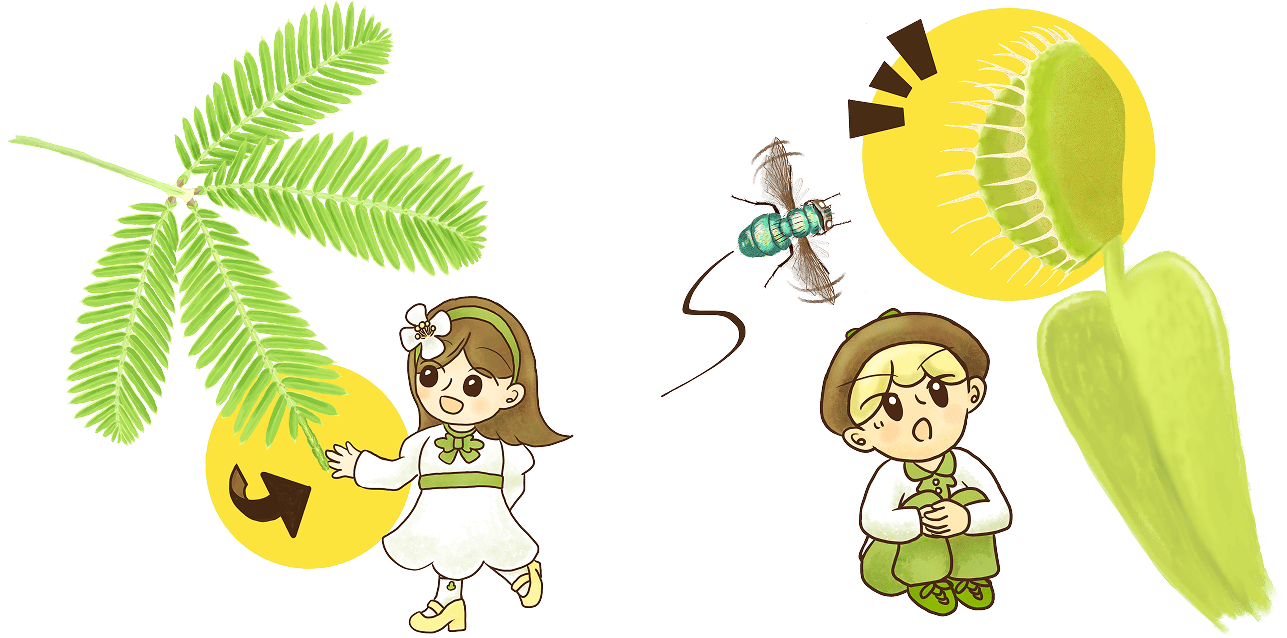
Plants have the remarkable ability to sense “touch” and “smell.” In our research, we use advanced observation tools to investigate how plants detect stimuli and how they transmit this information to other plants. The ERATO TOYOTA Plant Sensory Transduction Project aims to uncover the “senses” that plants possess and explore ways to contribute to the future of agriculture and environmental conservation. Plants and animals have long been considered very different kinds of organisms, but this perspective may be changing.

News
-
Award
Prof. Toyota Receives the 34th Kihara Memorial Foundation Academic Award!
-
Award
Dr. Takeshima Receives an Award at the 76th Annual Meeting of the Japanese Society of Breeding
-
Publication
Prof. Toyota Featured on CBC Radio
-
Publication
Collaborative Research with Nara Institute of Science and Technology Published in "Nature Communications"
-
News
Research Activities Fully Underway at Our New Hub!
-
Award
Prof. Toyota Receives the 9th Okazaki Award!
-
Seminar
The 6th ERATO Seminar
-
Seminar
The 5th ERATO Seminar
-
News
Assoc. prof. Satoshi Ogawa Gives a Talk at a Special Event at the Kawaguchi Science Museum
-
Media
Our Research Featured on a Korean Educational TV Program!
-
News
Research by Dr. Hiraku Suda and Prof. Masatsugu Toyota Featured in Editor’s Highlights of the Scientific Journal "Nature Communications"!
-
Award
Dr. Takeshima Receives an Award from the Japanese Society of Breeding
-
Seminar
Kick-off Symposium of the ERATO TOYOTA Plant Sensory Transduction Project
-
News
New Member Announcement: Dr. Shuntaro Ono Joins Our Lab!
-
Award
Revealing the Venus Flytrap’s “Tactile Sensor”(Dr. Hiraku Suda - Collaborative Research)
-
Seminar
The 4th ERATO Seminar
-
Seminar
ERATO Symposium Report – The 89th Annual Meeting of the Botanical Society of Japan
-
Member
Update: Dr. Keisuke Suda’s Page
-
Member
Update: Dr. Ryoma Takeshima’s Page
-
Member
Update: Prof. Masayoshi Nakamura’s Page
-
Member
Update: Assoc. prof. Kazuo Ebine’s Page
-
Member
Update: Assoc. prof. Hironori Takeda’s Page
-
Member
Update: Assoc. prof. Satoshi Ogawa’s Page
-
News
New Member Announcement: Dr. Ryoma Takeshima Joins Our Lab!
-
Seminar
The 3rd ERATO Seminar
-
Seminar
Dr. Yuko Amikura Gives a Lecture at Saitama University’s “Women in Science Seminar – Intensive Summer Program”
-
Publication
Revealing the Initial Motion Dynamics of the Venus Flytrap
“Inference of Mechanical Forces through Three-Dimensional Reconstruction of the Closing Motion in Venus Flytrap Leaves” -
Event
The 1st Summer Science Workshop for Elementary and Junior High School Students
-
Seminar
The 1st International ERATO Symposium
-
News
Official Website for the ERATO TOYOTA Plant Sensory Transduction Project Now Open!
-
Material
Let’s Learn at Home! Download Learning Materials
-
Event
The 1st Summer Science Workshop for Elementary and Junior High School Students - Registration Open!
Q1
Do plants also have senses?
We humans gather information from the world around us by seeing with our eyes,
hearing with our ears, smelling with our nose, and touching with our hands.
But what about plants?
Even though they don’t have eyes, ears, or noses, they sense things like light, wind, temperature, and scents as they grow.
For example, plants grow toward sunlight.
The sensitive plant (Mimosa pudica) folds its leaves when touched.
The Venus flytrap closes when an insect touches the inside of its leaves.
So how do plants sense what is happening around them?
Q2
What kinds of senses do plants have?
Our research has shown that plants are highly sensitive to changes in their surroundings and respond to them. We have also found that they can transmit this information to nearby plants.
Q3
How do plants transmit information?
We use Arabidopsis thaliana to study how it senses when its leaves are touched, using specialized equipment. First, let’s play the video! What do you think will happen?
An experiment to study the responses of Arabidopsis thaliana
We’ll explain what the flash of light in the video was and why it happened!
Studies have shown that when Arabidopsis thaliana is stimulated on its leaves, a substance called calcium ion travels through the plant.
In the video, the yellow flashes represent calcium ions moving within the plant. After the leaf is eaten by insects, you can see the yellow signal (calcium ions) spreading to other leaves! In our research, we have developed a specialized microscope that allows us to observe this yellow light.
Q4
What will we discover as the research moves forward?
How do plants transmit signals when they are touched?
How do plants respond when they sense a smell?
What happens inside their cells?
Although we know that plants can sense changes in their surroundings, the mechanisms behind this ability are still not fully understood.
Uncovering these mysteries is a major goal of our research.
As our work progresses, it may lead to new ways for plants to grow strong and healthy on their own, even with less pesticides.
Members
We’re the members of the research project!
Optical Equipment Development Group
Group Leader
Group Leader
Group Leader
Group Leader
Sub-Group Leader
Sub-Group Leader
Sub-Group Leader
Sub-Group Leader
Outreach
Let's learn together!
We offer free educational materials to help you feel closer to plants at home or at school.
We also host science events throughout the year.
About Us
Our Vision for Creating This Website
This website was created in a friendly and accessible way, so that many people can enjoy learning about plants. It is designed not only for those who want to explore our research more deeply, but also for people who may not usually be interested in science, encouraging them to think, “Maybe I’ll take a look.” If you’d like to discover even more about the fun and fascinating world of plants, feel free to join our events or try out our free learning materials.