


Technology theme: Innovative Hydrogen liquefaction technologies desired in future society
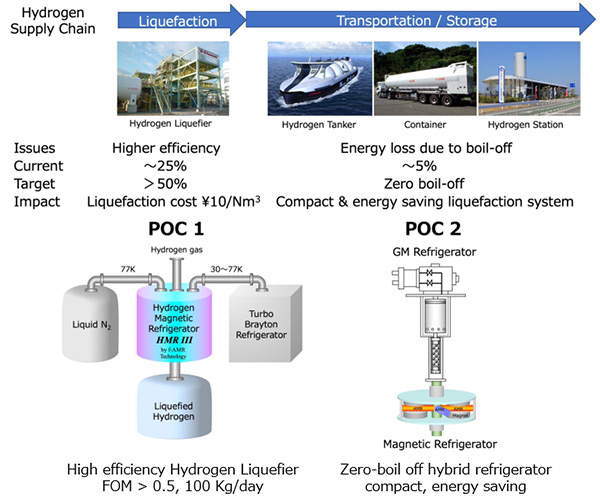
To realize a future society advanced in energy saving and carbon lowering, the utilization of liquid hydrogen is essential. Liquid hydrogen has as a volume 1/800 that of hydrogen gas, and advantages related to mass transportation, mass supply, mass storage, space saving, and super-high purity. The present hydrogen liquefaction process with a compressor has disadvantages, including low liquefaction efficiency at manufacturing and loss resulting from evaporation. The development of high-efficiency, low-cost, compact, durable, and innovative technologies for hydrogen liquefaction is expected to enable the mass utilization of hydrogen and contribute to an increased volume of hydrogen use for hydrogen power generation, storage of surplus power, and means of transportation.
Development of advanced hydrogen liquefaction system by using magnetic refrigeration technology


| R&D Period | 2018.11- |
|---|---|
| Grant Number | JPMJMI18A3 |
| Project Summary | Summary (PDF:388KB) (PDF:388KB) |
Summary:
Liquid hydrogen has a volume approximately 1/800 that of gaseous hydrogen, offering advantages such as large-scale transport, supply, and storage. However, its extremely low liquefaction temperature of 20 K (−253°C) requires substantial energy input. Achieving high liquefaction efficiency—beyond the limits of conventional gas-cycle refrigeration—is essential for cost reduction.
In this project, we aim to advance the development of high-performance magnetic materials and the construction of high-efficiency magnetic refrigeration systems toward the deployment of intrinsically high-efficiency magnetic refrigeration technology. By integrating these technologies, we develop a system capable of flexibly switching between hydrogen liquefaction and recondensation.
Furthermore, through the practical deployment of this technology, we will expand the utilization of liquid hydrogen and support the establishment of a hydrogen value chain.
R&D Team
[Leading Institution]
National Institute for Materials Science (NIMS)
[Collaborators]
National Institute for Materials Science, Kanazawa University, NIT Oshima College, National Institute for Fusion Science, University of Tsukuba, Kyushu University, MIRAPRO, Ebara Corporation, Mayekawa Mfg., JX Advanced Metals, Kyocera
Project Website
|
Affiliation and job title should automatically appear from the information that a researcher registered with researchmap.
Data may be outdated or undocumented. When there is not a connection via the internet, data are not displayed. |