Progress Report
The Realization of an Avatar-Symbiotic Society where Everyone can Perform Active Roles without Constraint7. Field experiments in the real world
Progress until FY2022
1. Outline of the project
We are developing a field experiment platform that incorporates a specialized communication environment for cybernetic avatars (CAs), allowing us to conduct practical experiments in collaboration with multiple companies. To facilitate this, we will establish a corporate consortium for the project and aim to have approximately 10 companies participate in the field experiments. Through these field experiments and related activities, we will disseminate the results of our R&D project to the world, envisioning the emergence of a new world characterized by an avatar-symbiotic society. Within the scope of this project, we will conduct focused field experiments on mental health care for individuals with mental disorders such as developmental disabilities and depression, as well as social participation for the older adults, in order to explore the realization of CAs and address associated challenges.
2. Outcome so far
- Development of Field Experiment Platform
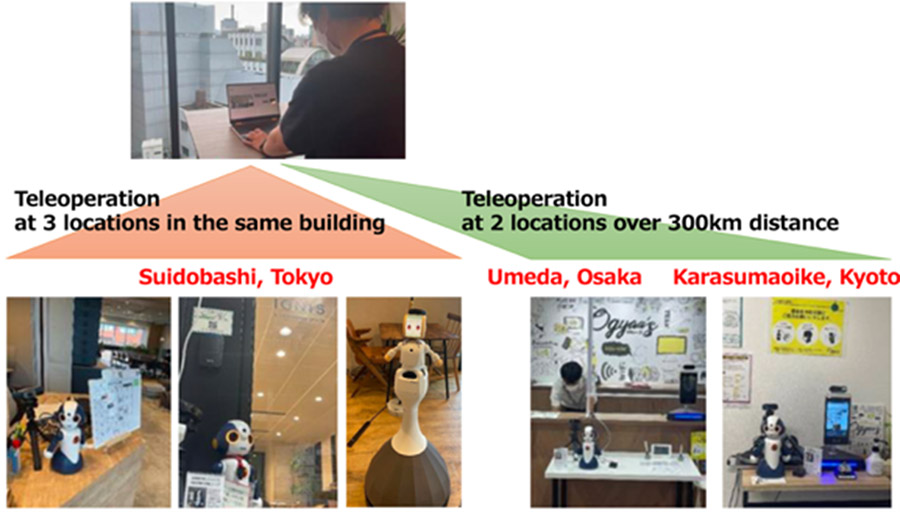
We have constructed a field experiment platform consisting of three CAs capable of providing reception and guidance services. The platform includes tele-operation software (CA-PF), CAs, and a sensor network for measuring the environment. Regarding communication for CAs, we have extended the core system of 5G communication and implemented 5G resource control technology, which allocates appropriate wireless communication resources based on the predicted locations of mobile CAs. In collaboration with R&D themes 1 and 7, we have developed a mobile CA (Teleco) and a location-fixed CA (Geminoid-TK, a human-like CA with detachable skin). We have conducted a long-term field experiment for reception and guidance at corporate entrances, multi-location reception experiments where a single tele-operator handles reception at three incubation offices (Tokyo, Kyoto, and Osaka), and a field experiment to investigate the social acceptance of official duties performed by CAs at department stores by utilizing the platform.
- Field Experiments on Mental Health Care for Individuals with Mental Disorders and Social Participation for Older Adults
In the field of mental health care, to appropriately select facial expressions and behaviors that correspond to each individual's mental state, we modeled the settings of them based on a database of interactions, conversations, and physiological data during interactions with individuals with developmental disabilities and patients with depression, which was constructed last year. Furthermore, we conducted field experiments with CAs in medical and educational settings at 12 facilities.
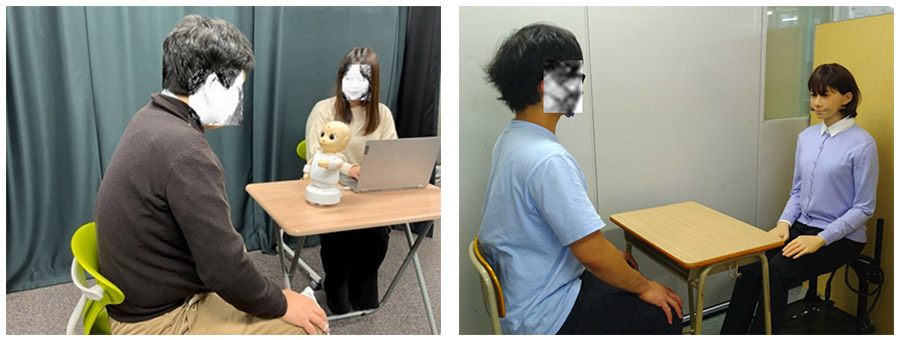
For the experiments targeting the older adults, we developed an interface that allows tele-operation of two CAs and conducted the experiments with the older adults using two tasks. With the cooperation of Sakai City in Osaka, we also established a tele-operation experiment base in Senboku New Town.
- Corporate Consortium
The corporate consortium for Avatar-Symbiotic Society currently has 105 corporations registered as members as of the end of March 2023. Within the consortium, four subcommittees have been formed according to industry and business type, to explore new business opportunities utilizing CA while showcasing the achievements of this project.
3. Future plans
We will continuously improve the field experiment platform and conduct field experiments. In particular, we will focus on back casting type field experiments to disseminate the project concept to general public. Based on the results of these experiments, we will provide feedback on issues and challenges to each R&D theme and incorporate them into the establishment of the CA-PF and international standardization activities carried out under R&D theme 5.