


Project
 Basic concept
Atomic nuclei are the building blocks of all visible matter, from inorganic materials to the human body and, eventually the universe.
Typically, a nucleus consists of protons and neutrons, which are collectively called nucleons.
Nuclear properties, such as half-life, binding energy, excitation energy, radius, and deformation,
are widely utilized in a variety of applied scientific fields ranging from medicine, environment, agriculture, industry, and historical research.
Understanding the emergence of nuclear properties from first principles is a dream of nuclear physicists.
The nuclear force is responsible for the binding of protons and neutrons in an atomic nucleus and the emergence of nuclear properties.
Since Hideki Yukawa's meson theory in 1935, it has been believed that once the nuclear force acting between two nucleons
(two-nucleon force, 2NF) is established, nuclei can be fully understood. Recently, the importance of the three-nucleon
force that acts in more than two-nucleon systems is strongly indicated in various nuclear phenomena,
which was initiated in the high-precision experiments of the three-nucleon scattering by the research director Kimiko Sekiguchi.
Meanwhile, so far, the knowledge of the three-nucleon forces is pre-matured, unable of applying them to the description of the nuclear phenomena with high predictability.
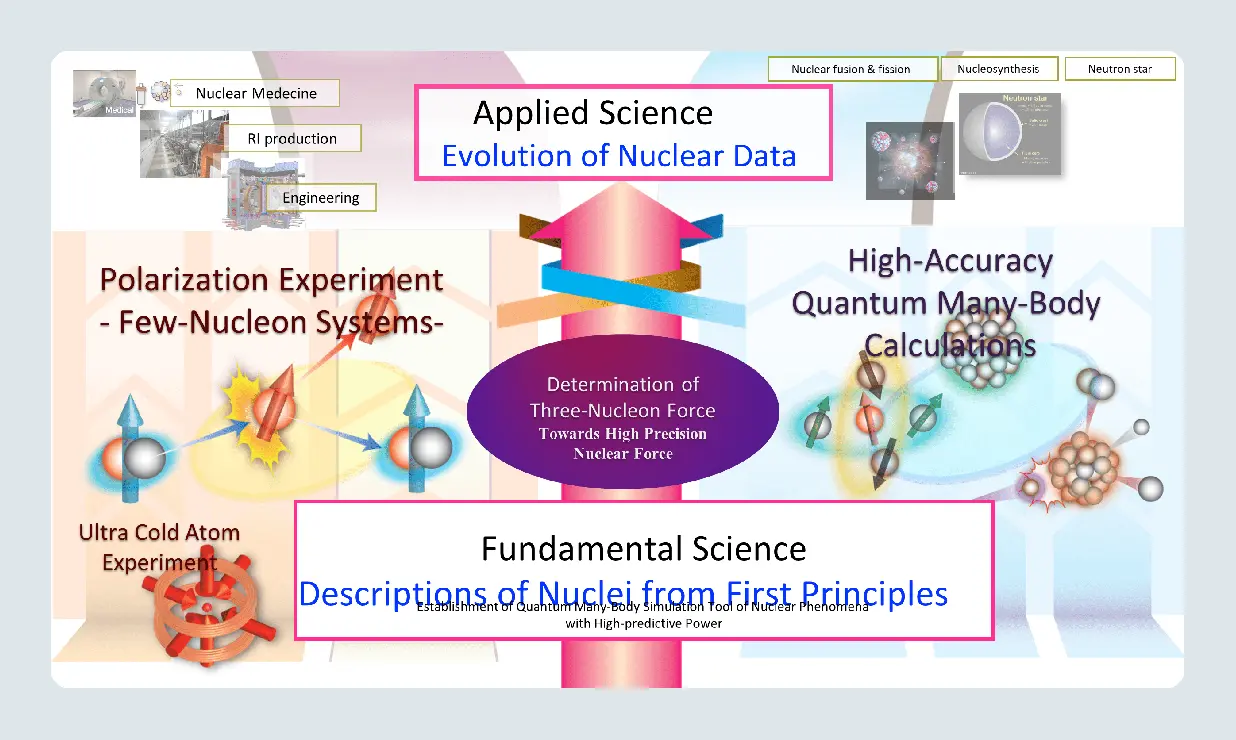
In this project, to establish the accurate and precise nuclear force,
the coupling constants of the three-nucleon force are determined from high-precision polarization experiments on few-nucleon systems and the most reliable theory,
i.e. the chiral effective field theory of nuclear force.
Next, a quantum many-body precise calculation method using the nuclear force is established by utilizing Japan's own supercomputer, Fugaku.
The cold atomic system is developed to simulate the simplest systems of the nucleus and then to test the calculation to be developed.
By strengthening the fundamental science that describes nuclei from first principles,
we aim to formulate the quantum many-body simulation tool to describe nuclear properties with extremely high predictive power.
This will be extended to the field of applied science via the nuclear data library.
 Research group
In this project, the research items necessary to realize the above concept will be divided into four groups:
According to the project, it will be possible to make highly accurate predictions of physical properties of nuclei that cannot be measured experimentally. In addition, the highly reliable quantities of physical properties of nuclei and reaction cross sections of nuclei obtained in the project will be extended to research in the field of applied sciences.
Group A aims at determining values of coupling constants of three-nucleon force formulated based on the chiral effective field theory for nuclear force from experimentally measured data, to complete the nuclear force including the three-nucleon force. Group A consists of an experiment group that performs precise measurements for few-nucleon systems and a theory group that studies three-nucleon force based on the chiral effective field theory for nuclear force.
Group B consists of three subgroups, to establish precise calculations of quantum
many body systems
for nuclei in cooperation with each other.
Group B1 aims at realizing an exact many-body calculation method utilizing the
nuclear force
established by Group A, and a calculation method explicitly incorporating
correlation between nucleons
for 10 to 20 body systems.
Group B2 aims at solving 100 body problem. High-relability functionals will be
established, and
precise values of physical properties of nuclei that can be directly compared with
experimental data
will be provided.
Group B3 aims at establishing nuclear reaction theories using wave functions
provided by Groups B1 and
B2 and predicting reaction cross sections of nuclei required for application fields.
Group C prepares a system of particles interacting with each other within a shell structure with a cold atom system, and observes wave functions and excitation spectra of cold atoms. By comparing measured values obtained from the measurement by Group C with values obtained from the calculation performed by Group B, the accuracy of estimation of precise calculations for quantum many body systems established by Group B will be guaranteed.
In the field of applied sciences, wide variety of researches have been developed by
using physical
properties of nuclei and/or reaction cross sections of nuclei. The field ranges from
engineering/industry, agriculture, medicine, space science, geoscience, humanities
and the like.
The developments in the field of applied sciences are supported as background by
significant
activities in the field of nuclear data. Recently, it has been found that
experimental data are
insufficient as sources of the nuclear data. Especially, very few reliable
experimental data are
available by experiments for nuclei having very short lives, experiments requiring
large-scale
experimental systems, experiments of precise measurement of half-lives for nuclei
having long lives,
and the like. Further enhancement of the nuclear data requires provision of reliable
data of these
experiments.
Researchers of the field of nuclear data, researchers of the field of library constructed by evaluating nuclear data, and researchers of the field of nuclear chemistry and/or nuclear medicine, as users of nuclear data, participate in Group D.

