


- JST Home
- /
- Strategic Basic Research Programs
- /
 CREST
CREST- /
- Research Director/
- Precise arrangement towards the functionality of molecular systems/
- [Precise arrangement toward functionality] Year Started : 2022
[Precise arrangement toward functionality] Year Started : 2022
Yasuhiro Ishida
Mechanically Polar Gel for Rectifying Materials, Energies, and Creatures Against the Increase of Entropy
Grant No.:JPMJCR22B1
Research Director
Yasuhiro Ishida
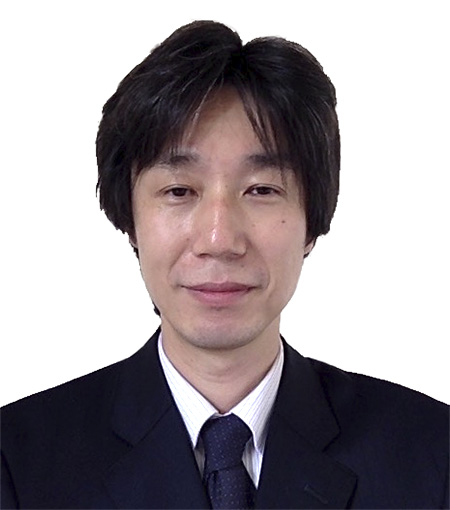
Team Director
Center for Emergent Matter Science
RIKEN
Collaborator
| Dai Okumura | Professor Department of Mechanical Systems Engineering Nagoya University |
| Satoru Kidoaki | Professor Institute for Materials Chemistry and Engineering Kyushu University |
| Nobuyuki Sakai | Principal Researcher Research Center for Materials Nanoarchitectonics National Institute for Materials Science |
| Asuka Takeishi | Associate Professor Graduate School of Science Kobe University |
Outline
Many materials are known to respond polar to physical stimuli such as electric fields, magnetic fields, and light. Meanwhile, materials that respond polar to force have never been imagined. We recently discovered the first mechanically polar gel material, which exhibits different elastic moduli in response to left-sided and right-sided shears. In this project, we aim to establish the scientific principle of the mechanically polar gel in theoretical and experimental approaches. We also aim to demonstrate various unique functions of this gel, making use of its intrinsic ability to rectify the flow of objects and energies against the increase of entropy.
Mitsuhiko Shionoya
New Material Science Pioneered by Precise Design and Arrangement of Multi-Element Metal Ion Clusters
Grant No.:JPMJCR22B2
Research Director
Mitsuhiko Shionoya
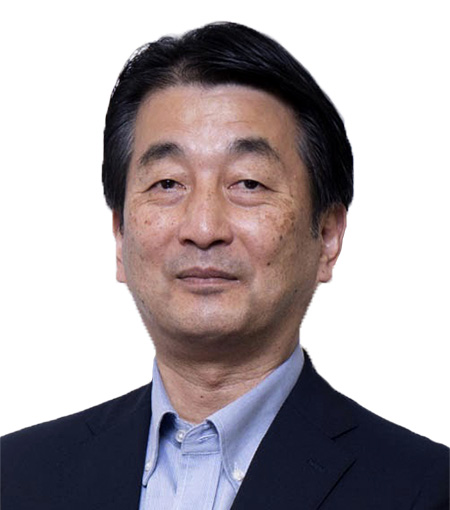
Professor
Organization for Research Promotion
Tokyo University of Science
Collaborator
| Masahiro Ehara | Professor Research Center for Computational Science National Institutes of Natural Sciences |
| Takeaki Ozawa | Professor Graduate School of Science The University of Tokyo |
Outline
This research targets multi-element metal-ion clusters consisting of metal ions and core/shell ligands, as well as multidimensional self-assemblies of unit clusters. Through experiments, theory, and measurements, we aim to establish design concepts and synthesis techniques for precise arrangement methods of atoms and molecules, and to systematize new material groups. Furthermore, we will pioneer bonding, physical properties, and reaction theories describing structure-specific properties, and develop highly stable clusters for photo-bioanalysis and highly active clusters for catalytic chemistry, opening up a new dimension in materials science.
Takuji Hatakeyama
Precise synthesis and arrangement of BN-embedded nanocarbon molecules
Grant No.:JPMJCR22B3
Research Director
Takuji Hatakeyama
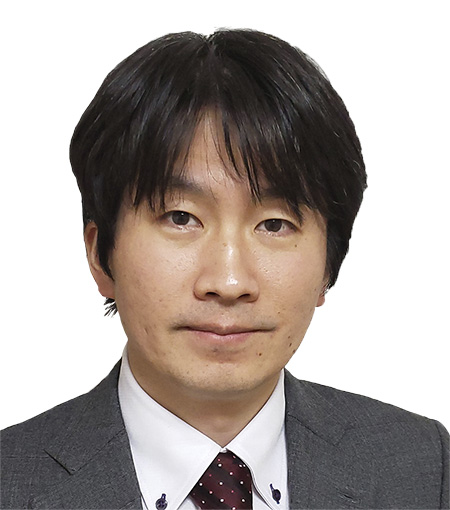
Professor
Graduate School of Science
Kyoto University
Collaborator
| Chihaya Adachi | Professor Graduate School of Engineering Kyushu University |
Outline
In this research, we synthesize “BN-embedded nanocarbon molecules” with a giant π-conjugated system in which carbon, boron, and nitrogen are precisely arranged, and control their orientation in devices to realize next-generation organic optoelectronics. Furthermore, by combining fine organic synthesis and chemical vapor deposition, we aim to synthesize “BN-embedded nanocarbons” with controlled atomic arrangement.
Yutaka Majima
Systematic functionalization of photo-aligned single-molecule crosslinked resonant tunnel transistors
Grant No.:JPMJCR22B4
Research Director
Yutaka Majima
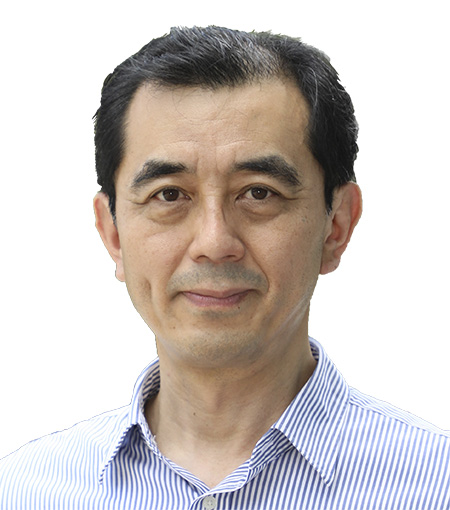
Professor
Institute of Integrated Research
Institute of Science Tokyo
Collaborator
| Tomoya Ono | Professor Graduate School of Engineering Kobe University |
| Kohtaroh Kajikawa | Professor School of Engineering Institute of Science Tokyo |
| Ryo Shintani | Professor Graduate School of Engineering Science The University of Osaka |
Outline
We will conduct research on: 1) in-situ observation and organization control of single-molecule photo-aligned crosslinking process between electroless-Au plated nanogap electrodes; 2) innovative synthesis of novel π-conjugated molecules for organization and functionality of single-molecule transistors; 3) analysis of the assembling process and conduction properties of single-molecule crosslinking systems based on theoretical calculations and device design; 4) creation of single-molecule crosslinked resonant tunnel transistors that operate at room temperature; and establish fundamental science and technology for the systematic functionalization of single-molecule cross-linked resonant tunnel transistors.