Progress Report
Last updated:
Development of Quantum Interfaces for Building Quantum Computer Networks[1] Diamond Quantum Memory
Progress until FY2025
1. Outline of the project
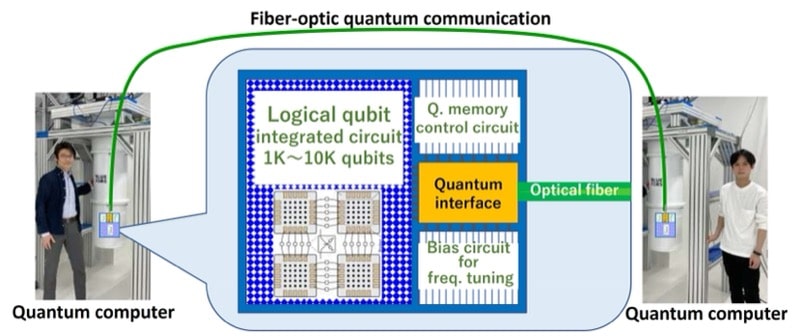
We are developing quantum interfaces that connect superconducting quantum computers with optical fiber quantum communications to realize a distributed quantum computer system (Fig. 1). The core of this project is the quantum memory and optomechanical crystals, and integrated development from the diamond growth and nanofabrication to 3D mounting has been carried out. In this R&D theme, we have achieved the following outcome.
2. Outcome so far
Subject 1: Diamond Quantum Memory
Improving Quantum Memory Performance and Optical Interconnection
We developed high-speed and high-fidelity (99.97%) quantum memory devices using nitrogen-vacancy (NV) centers in diamond, and demonstrated a two-node connection via photon emission and absorption (Fig. 2). Furthermore, by implementing orbital control of the neutral charge state, we achieved a microwave coupling strength 1,000 times greater than conventional methods.

Microwave-to-Optical Quantum Interface
Within a diamond nanophotonic structure, we coupled microwave-induced mechanical vibrations with a Tin-vacancy (SnV) center. This enabled the successful demonstration of a quantum interface that interconnects microwave and optical photons (Fig. 3).

Subject 2: Diamond Quantum Structures
Fabrication of diamond nanostructures
To improve the efficiency of spin manipulation using acoustic waves, we optimized the pattern dimensions of the IDT electrodes and refined the resonator structure. In parallel, we established microfabrication processes for quantum structure fabrication, including electron-beam lithography, etching, insulating film deposition, and electrode formation. Furthermore, we successfully prototyped a membrane structure with a thickness of approximately 200 nm using the smart-cut method based on ion implantation (Fig. 4).

Subject 3: Diamond Quantum Crystals
Diamond high-purity crystal growth
We have performed high-purity diamond crystal growth and impurity control to stabilize the charge state of NV centers and reduce their spectral diffusion.
Subject 4: Diamond Color Centers
Development of nano-ion beam for precision implantation
We developed a technique for implanting a controlled number of ions into diamond nanostructures with high positional accuracy. First, a string-type Coulomb crystal was formed in a Paul trap, and ions were extracted by precisely controlling the DC voltages confining the crystal (Fig. 5). Finally, we also succeeded in extracting and irradiating ions one by one.

3. Future plans
We aim to improve the performance of diamond optomechanical crystal resonators (OMCs) incorporating quantum memories and demonstrate a superconducting–optical quantum interface.