Interviews
From IIT Bombay to Fujitsu
How JST's LOTUS Programme Connects Global Talent with Japan
Spotlight on a LOTUS 2024 Participant: Ashwin Aravind (Fujitsu Limited)
The LOTUS Programme, supported by the Japan Science and Technology Agency’s (JST) Sakura Science Exchange Program, aims to promote Japan-India joint research through strengthened collaboration and network building between research institutions in Japan and India.
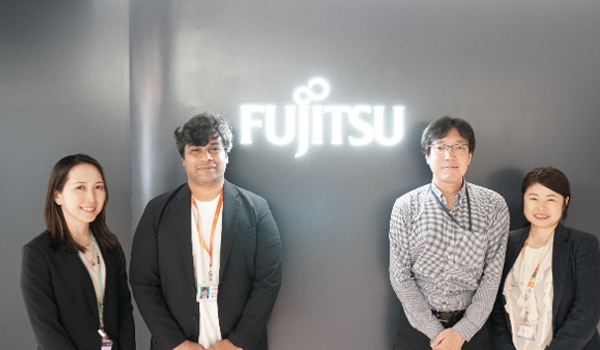
In this installment, we feature Ashwin Aravind, a former doctoral student from India who conducted research at Kyoto University through the Programme. Following its completion, Ashwin participated in an industry internship program led by Japan’s Ministry of Economy, Trade and Industry (METI). He subsequently joined Fujitsu Limited, one of Japan’s leading information and communications technology (ICT) companies, as a researcher, where he is now engaged in full-time cutting-edge research and development.
Through interviews with both Ashwin and his host company, this article explores his journey and accomplishments as a successful example of how collaboration among government, academia, and industry can attract, develop, and retain highly skilled international talent in Japan.
Interviewer Profile
-
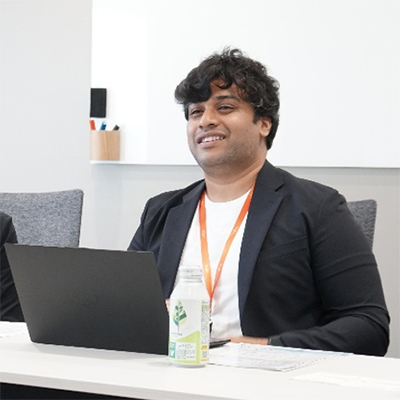
ARAVIND ASHWIN
After completing a degree in Electrical and Electronics Engineering at the University of Kerala and entering the workforce, returned to complete a master's degree and Ph.D. at IIT Bombay. His research focuses on systems and control engineering, optimization and robotics. Joined Fujitsu Limited in April 2026.
【Project Title】Mathematical Foundations for Robust Control System Design Integrating Learning and Optimization
■Principal Investigator (Japan Side): Professor Toshiyuki Ohtsuka, Graduate School of Informatics, Kyoto University
■Principal Investigator (India Side): Professor Debasish Chatterjee, Indian Institute of Technology Bombay
■Invitee: ARAVIND ASHWIN (PhD student, at that time)
Q1. How did your academic journey lead you toward a research career in Japan?
A1. I completed a Bachelor of Technology in Electrical and Electronics Engineering and began my career as an electrical engineer at a tire manufacturing company. However, I soon felt compelled to return to university. Because I was more interested in research and had a strong desire to contribute to advances in science and technology, which led me to pursue a master's degree. It was at IIT Bombay that I met Professor Debasish Chatterjee, who had a major impact on my research journey. He encouraged me to continue on to a Ph.D. and was also highly supportive of gaining international research experience. Under his guidance, my research moved into the fields of systems and control engineering, focusing on algorithms for optimization, control, and learning. As my research progressed, I became increasingly interested in understanding how these mathematical theories could be applied to real-world physical systems. Japan's longstanding strengths in robotics research, led by companies such as Honda, made it a particularly attractive destination for pursuing these interests. The encouragement to build international collaborations motivated me to seek research opportunities abroad. This eventually brought me to Japan, first through a placement at the Kyushu Institute of Technology under the Sakura Science Exchange Program and later through the LOTUS Programme, where I conducted research at Kyoto University. Through these experiences, I became increasingly convinced.
Q2. What did you gain from participating in the LOTUS Programme and the subsequent internship in Japan?
A2. Through the LOTUS Programme, I joined the laboratory of Professor Toshiki Ohtsuka at Kyoto University. Having continued to seek out research opportunities in Japan following my earlier visit through the Sakura Science Exchange Program, I saw LOTUS as the bridge I had been looking for. While my background was largely in modern control theory and optimization, Professor Ohtsuka's expertise lay primarily in integrating classical control approaches with modern learning algorithms. Rather than remaining within my own area of specialization, I used the opportunity to explore how these different approaches could be combined. We tried to see how classical control can be based on modern algorithms. We worked on robust optimization algorithms and explored how nonlinear control can be achieved using modern techniques. While my research in India and at Kyoto University was primarily theoretical, Fujitsu provided me with an opportunity to implement and validate those ideas on real hardware. This experience allowed me to see how the mathematical theories I had developed could be connected to adjacent fields and ultimately applied to real-world systems. What Fujitsu gave me was an opportunity to implement what I had done theoretically and see how it works in practice. Being able to clearly visualize how my theoretical approaches could be applied beyond the laboratory proved to be a major turning point in my career and helped reinforce my desire to pursue research and development opportunities in Japan.
Q3. Why did you decide to join Fujitsu after your internship in Japan?
A3. I am very interested in the social implementation of cutting-edge technologies, which is why I participated in an internship at Fujitsu. Here, I received exceptionally thorough support while being given a great deal of autonomy to first formulate my own hypotheses and try them out, which allowed me to truly enjoy the process of achieving my goals. I felt that this was an environment where I could develop the mathematical theories and AI expertise I had cultivated by directly applying them to practical, cutting-edge industrial needs, such as Physical AI, which is why I decided to join the company.
This opportunity to connect theory with real-world applications became one of the main reasons I chose to remain in Japan after my internship concluded. What Fujitsu gave me was an opportunity to implement what I had done theoretically and see how it works in practice.
This opportunity left a strong impression on me and convinced me that Fujitsu was a place where I could continue to develop as a researcher.
Q4. What would you say to students who are considering applying for the LOTUS Programme?
A4. I strongly recommend the LOTUS Programme to future participants. I really enjoyed this opportunity. I think the people coming over for the next intake should try to interact with different researchers as much as possible and try to learn as much as possible.
I would encourage students who are thinking about doing research in Japan to take the leap and, once here, take advantage of every opportunity to interact with researchers both inside and outside their host laboratories.
However, my most important piece of advice is surprisingly simple. The biggest thing that you should do in Japan is to enjoy yourself. There are so many nature trails and places to explore. Go there, take a walk around, and go on hikes. It will really open up a new way of life to you.
Beyond the research opportunities, I believe that experiencing Japan's culture, nature, and way of life is an equally valuable part of the LOTUS journey.
Interview with the Host Company
A New Pathway for Recruiting Global Talent
Mr. ABE Narishige

Q1. What was the background behind accepting highly skilled talent from India through an internship?
A1. Fujitsu has long maintained subsidiaries and research facilities in India and has actively recruited talent there. However, conventional hiring processes that rely primarily on interviews make it difficult to fully assess a candidate’s technical potential, problem-solving approach to unfamiliar challenges, and ability to integrate effectively into a team.
Internships can provide an opportunity for both the company and the candidate to evaluate practical capabilities and personal qualities that cannot be fully understood from a résumé alone through direct collaboration in an actual development environment. We viewed this as a highly effective approach for identifying and recruiting truly outstanding global talent while reducing the risk of hiring mismatches.

Q2. What was your assessment of Ashwin's performance during the internship?
A2. In short, Ashwin exceeded our initial expectations. He demonstrated an exceptionally high level of expertise and technical capability, and based on our experience recruiting in India, he shows outstanding talent in terms of both technical competence and initiative.
At Fujitsu, we recently launched a new research initiative focused on Physical AI—AI technologies that enable humans and machines to collaborate in real-world environments. We are currently advancing the development of Fujitsu Kozuchi Physical OS, a platform that brings together the technologies needed for people and multiple robots to work collaboratively in everyday settings.
Although Ashwin did not have extensive prior experience specifically in Physical AI, he successfully applied the advanced mathematical control theory developed at the Indian Institute of Technology Bombay (IIT Bombay), one of the world’s leading engineering institutions. He proactively identified research challenges on his own and consistently drove the project forward. Within less than two months of joining the team, he has already become an indispensable member.
Q3. What was the key factor in your decision to hire him as a full-time employee following the internship?
A3. What stood out most was his ability to formulate hypotheses, anticipate future challenges, and act independently to address them. In fast-moving fields such as AI and robotics, simply completing assigned tasks is not enough.
During the internship, Ashwin demonstrated the ability to identify emerging technological trends and propose practical solutions on his own initiative. This was precisely the type of talent we are seeking.

Q4. Were you concerned about potential language or cultural barriers when bringing in international talent?
A4. Language and cultural differences were not a major concern. English is commonly used in our R&D activities, both in discussions with international research partners and in our day-to-day collaboration with overseas researchers within the company.
Ashwin was highly proactive in building relationships with colleagues, for example by going to lunch with team members who are native Japanese speakers. His diverse background has brought fresh perspectives and positive energy to our organization.

Q5. What value do you see in programmes such as LOTUS from the perspective of industry–academia–government collaboration?
A5. It is not easy to establish meaningful connections with exceptionally talented students and researchers at leading overseas institutions such as IIT Bombay through corporate recruiting activities alone. Likewise, opportunities for international students to gain first-hand exposure to the strengths and attractiveness of Japan’s industrial sector remain limited.
The JST programme provides a valuable framework that connects international collaborative research between universities with corporate internships and, ultimately, employment opportunities in Japan. From the perspective of industry–academia–government collaboration, we believe this creates a meaningful pathway for both talent development and talent acquisition.
Looking ahead, further enhancements to support systems—such as assistance with daily life and relocation for international participants—could strengthen this framework even further. We believe it has the potential to become a powerful foundation for promoting talent mobility and driving innovation across Japan. As a company, we strongly hope to see this outstanding initiative continue to grow and expand in the years ahead.