Program
Last updated:

Moonshot Goal10Realization of a dynamic society in harmony with the global environment and free from resource constraints, through diverse applications of fusion energy, by 2050.
Program Director (PD)YOSHIDA ZenshoProject Professor, Graduate School of Mathematical Sciences, The University of Tokyo
Outline
In order to put fusion energy (energy produced by nuclear fusion reactions) to practical use, innovation that realizes stable energy generation systems and building scientific knowledge that can accurately predict the complex phenomena involved is essential.
This R&D program will cast back from society in 2050, where fusion energy is implemented into various applied technologies, to identify key issues that would have to be faced before implementation and to conduct R&D to find solutions to those issues. Furthermore, we aim to create disruptive innovations that implement fusion energy into society by collaborating across a wide range of scientific and technological fields.
A Vision of Society in 2050 (Illustrated Guide)

What might the future look like in 2050 if Goal 10 is realized? An illustrated guide.
Message from PD
Goal 10 has been formulated to create a vibrant society in 2050 that lives harmoniously with Earth’s environment by developing new fusion energy technologies. Researchers and engineers worldwide have been collectively working towards the ambitious dream of achieving practical applications of fusion energy for over 70 years. As the realization of this dream becomes more urgent, this R&D program seeks to play a key role in generating innovative technologies that can accelerate the research and development of fusion energy. To carry out this important mission, we have launched a R&D project that brings together researchers and engineers from a wide range of specialized fields to realize a society where fusion energy is used in power generation and various other scenes by 2050.
R&D Projects
Selected in FY2024
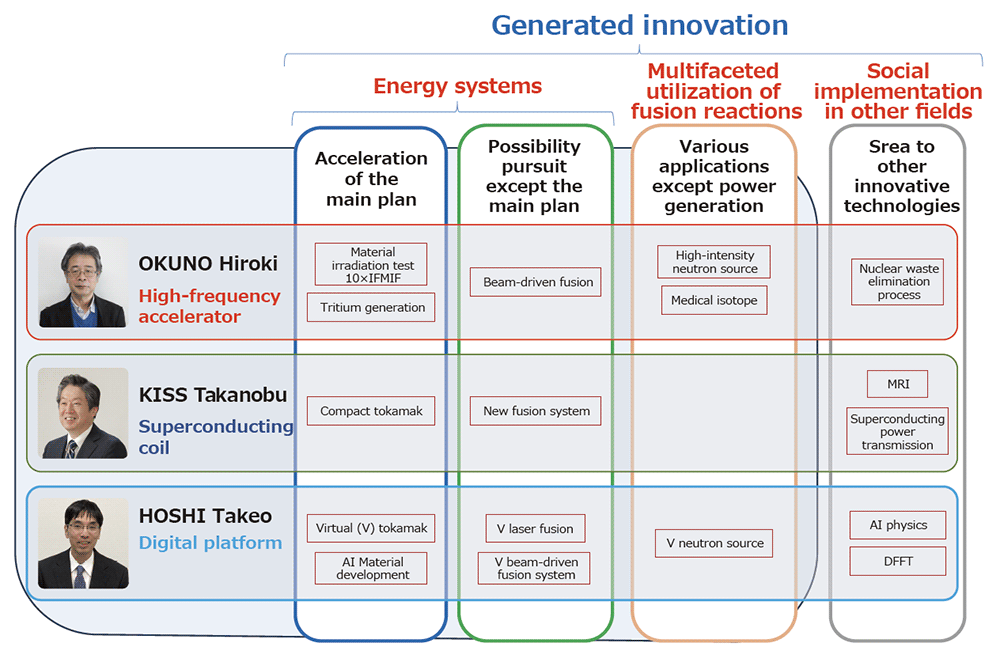
Development of High Intensity Neutron Source and Advanced Fusion System by Innovative Acceleration Technology
- Project Manager
- OKUNO Hiroki
- Group Director, Nuclear Transmutation Technology Group, Nishina Center for Accelerator-Based Science, RIKEN

This project aims to revolutionize fusion energy development by introducing innovative accelerator technologies. By establishing high-energy, high-output ampere-class beam accelerator technology, we enable the generation of large quantities of neutrons, thereby accelerating the development of fusion reactor materials. Additionally, by using automated cyclotron resonance accelerators for ion injection and heating, we will verify the feasibility of small-scale fusion reactors. This will help us aim for a future with a self-sustaining fuel society, one that does not increase high-level radioactive waste, a society coexisting with fusion energy, and a future supporting activities in uncharted spaces such as deep-sea and interplanetary travel.

Fundamental Superconducting Technology to Realize Various Innovative Fusion Reactor Concepts
- Project Manager
- KISS Takanobu
- Director, Research Institute of Superconductor Science and Systems, Kyushu University

This project aims to realize the early application of high-temperature superconductors to fusion reactors by establishing innovative mass production technologies for high-temperature superconducting wires and superconducting magnet technology that is resistant to neutron irradiation, stable against disturbances, and does not require liquid helium for operation. This will contribute to achieve the miniaturization and improved economic viability of fusion reactors. To this end, we will demonstrate 40-tesla-class high-temperature superconducting coils and high-capacity conductors. Furthermore, we will promote spillover effects in fields other than fusion, such as medical and mobility sectors, thereby realizing Japan's international superiority in superconducting technology and fostering talent.

Backcasting Digital Systems by Super Dimensional State Engineering
- Project Manager
- HOSHI Takeo
- Professor, National Institute for Fusion Science, National Institutes of Natural Sciences

This project aims to build a digital platform and virtual laboratories that will enable, in a digital space, the design and performance test of the fusion energy systems. To achieve this, we will utilize innovative AI and data-driven scientific technologies to develop computational methods that can accurately reproduce complex states such as plasma, where physical quantities are intricately intertwined, in a digital space. This will significantly reduce the time and cost required for the development and performance testing of prototypes, thereby aiming for cost reduction and early realization of diverse fusion energy systems.

Innovative Muon-Catalyzed Fusion Technology for Practical Applications
- Project Manager
- OKADA Shinji
- Professor, College of Science and Engineering, Chubu University

This project aims to establish the scientific foundation for highly efficient muon‑catalyzed fusion by dramatically increasing the number of fusion reactions induced by a single muon. Muon‑catalyzed fusion is a technique that enables nuclear fusion reactions using an elementary particle known as a muon. Unlike conventional fusion approaches, it does not require the extreme temperature and pressure conditions of a reactor core and is highly compatible with existing technologies. Through this project, we will achieve a positive energy balance in muon‑catalyzed fusion. By 2050, we aim to contribute to a sustainable society in harmony with the global environment through diverse applications such as distributed power sources and neutron sources.

Innovation in the Formulation and Solution Methods of Mathematical Models to Transform the Paradigm of Fusion Research
- Project Manager
- OZAWA Tohru
- Professor, School of Advanced Science and Engineering, Waseda University

This project aims to create new mathematical concepts and methodologies for the fusion energy field by fostering collaboration between mathematical sciences and plasma physics, grounded in the challenges of fusion research as well as its abundant experimental data and numerical simulations. To understand the complex phenomena of ultra‑high‑temperature plasmas and the systems that generate and sustain them, we will begin by mathematically formulating the core issues in fusion science. Through redefining key concepts and achieving disruptive innovation in methodology, this project will contribute to the early realization of fusion energy and to enhancing the performance and safety of future fusion devices.

Interdisciplinary Development of Advanced Fusion and Antimatter Science Using Superconducting Dipole Fields
- Project Manager
- SAITOH Haruhiko
- Associate Professor, Graduate School of Frontier Sciences, The University of Tokyo

This project aims to realize a neutron source based on a dipole magnetic field, a configuration analogous to planetary magnetospheres that can be formed and sustained stably with a relatively simple device configuration. We will extend this concept to apply interdisciplinary developments in antimatter science. To achieve this goal, we will use a high‑field superconducting dipole device to demonstrate ion heating and neutron production, thereby establishing the engineering foundation for a fusion‑based neutron source. Through these initiatives, the project will contribute to the broader utilization of fusion energy and to the realization of advanced fusion systems in the future.

Development of Innovative Isotope Separation System for the Realization of Compact Fusion Fuel Cycle
- Project Manager
- TANAKA Hideki
- Professor, Institute for Aqua Regeneration, Shinshu University

This project aims to establish high‑efficiency, low‑cost isotope separation technologies to realize domestic production and a stable supply of fusion fuels. To achieve this, we will develop adsorbents and ion‑exchange materials capable of sensitively recognizing the minute quantum effects that arise between isotopic molecules and ions, and pursue the creation of an innovative isotope separation system utilizing these materials. This will not only accelerate the social implementation of fusion energy as a baseload power source, but also contribute to the application of deuterium to high value‑added materials and to the realization of a resource‑circulating society for lithium‑ion batteries.

Development of Autonomous Breeding Blanket for Compact Fusion Reactors
- Project Manager
- TANIGAWA Hiroyasu
- Deputy Director, Department of Blanket Systems Research, Rokkasho Institute for Fusion Energy, National Institutes for Quantum Science and Technology

The aim of this project is to develop a compact and innovative fuel breeding blanket that will ensure the sufficient plasma volume essential for achieving the required fusion power output, even as the fusion reactor itself becomes more compact. This will enable ITER-size reactors to achieve the fusion power and stability required for commercial operation while reducing the plant's overall tritium inventory. By establishing this design as the global standard for fuel breeding blankets, the project will contribute to accelerating the worldwide deployment of fusion energy on a global scale.

Fusion Reactor Using Optical Enhancement Cavity Laser
- Project Manager
- FUJIOKA Shinsuke
- Professor, High Energy Density Science Research Division, Institute of Laser Engineering, The University of Osaka/Director, Blue Laser Fusion Energy Collaborative Research Institute

This project aims to develop a new type of power laser called the “OEC laser,” which stores optical energy in space. It focuses on achieving high-repetition-rate operation for practical use of laser fusion as an energy source and on establishing an autonomous research system called “OASIS,” which integrates laser irradiation, fuel delivery, diagnostics, analysis, and simulation. By leveraging OASIS, we will rapidly optimize the conditions for fusion ignition, systematically accumulate technologies and knowledge, and thereby contribute to the realization of laser fusion.

Development of Inertial Fusion Modules Powered by Blue-Violet Semiconductor Lasers
- Project Manager
- MORI Yoshitaka
- Associate Professor, Division of the Creation of New Photonics Industries, The Graduate School for the Creation of New Photonics Industries

This project aims to apply blue-violet semiconductor laser technology to establish a highly efficient laser driver for the realization of inertial fusion. The project will pursue the short-pulse operation and high-power performance of blue-violet semiconductor lasers, which are expected to achieve device level continuous wave efficiencies exceeding 50%. This high efficiency will significantly reduce the electrical power required to generate the high-intensity laser pulses needed to compress fusion fuel. Through this approach, the project aims to reduce the energy gain requirement for inertial fusion from the conventional level of around 100 to approximately 20, thereby advancing the realization of inertial fusion energy plants.

Advisors
Click here to see the list of advisors
| YAMADA Hiroshi* | Director General, National Institute for Fusion Science, National Institutes of Natural Sciences |
|---|---|
| ANDO Akira | Specially Appointed Professor, Advanced Graduate School, Tohoku University |
| UEDA Yoshio | Professor, Department of Electrical and Electronic Engineering, Faculty of Science and Engineering, Otemon Gakuin University |
| KAWACHI Tetsuya | Deputy Director-General at the Headquarters of the Quantum Science and Technology Agency |
| KONDO Hiroko | Representative of Matrix K,LLC) |
| TSUNETA Saku | Director, Astronomy Research Center, Chiba Institute of Technology |
| HATTORI Kenichi | Representative of Helicity X |
| MORII Takashi | Specially Appointed Professor, Office of Institutional Advancement and Communication, Kyoto University |
| YAMAZAKI Yasunori | Senior visiting scientist, RIKEN |
| YAMADA Michio | Project Professor, RIMS, Kyoto University |
*Sub Program Director
Goal 10 News
Contact
Goal 10 Secretariat
Department of Moonshot Research and Development Program, Japan Science and Technology Agency
e-mail moonshot-goal10 jst.go.jp