


Event Reports
The 1st & 2nd JST Research Integrity Workshop in 2025, "Let's use the Guidebooks on Gaps in Ethics 3"
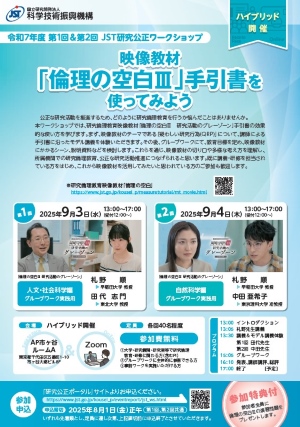
These workshops were planned with a focus on the guidebooks on "Gaps in Ethics 3," which bring together practical methods for utilizing these video materials. The aim of the workshops was to help participants understand various approaches to using the instructional videos and diverse ways of thinking, and to enable them to apply these insights to activities such as research ethics education at their respective institutions. Following a lecture by Prof. Fudano on the current state of and challenges in research ethics education, the participants heard lectures by Prof. Tashiro and Assoc. Prof. Nakata and got to experience model lectures planned to use the guidebook. After this, the participants did group work to examine educational objectives and explanatory materials for future training.
This report presents an overview of what took place on the day.
* See the instructional video and guidebooks of the "Gaps in Ethics" series here.
https://www.jst.go.jp/kousei_p/en/measuretutorial/mt_video_e.html
Lecture: Let's use the Guidebooks on Gaps in Ethics 3 (3 Sep. and 4 Sep.)
Professor Jun Fudano, Center for Higher Education Studies, Waseda University

He stated that the goal is to have moral autonomy, i.e., the ability to make independent decisions and take action to solve problems in ethically problematic situations.
Next, citing the NIH's guidance on responsible conduct of research (RCR), which was updated in FY2022, he emphasized that "we must reaffirm the principle that RCR education is a fundamental element of researcher development." He further noted that knowledge and understanding of research ethics need to be continually examined and noted that there are emerging issues such as peer review misconduct and AI-related matters, and ambiguous concepts such as duplicate submission, self-plagiarism, and salami slicing.
Prof. Fudano also mentioned creative ways to utilize teaching materials, noting that the "Gaps in Ethics" series of instructional videos presents simulated cases that enable learners to experience ethical dilemmas through virtual case studies. He also noted that incorporating post-viewing group discussions into learning will enhance its effectiveness by letting participants share their values and attitudes. Additionally, he identified the following advantages of using the video materials:
1. It enables the users to learn actively and gain experience of decision-making
2. It promotes empathy and perspective-taking, enhancing ethical sensitivity
3. It offers the benefits of simulation-based learning (solid knowledge in other fields)
4. It enhances the effectiveness of learning in hybrid-format education
5. It makes it easier to incorporate educational elements that lead to behavioral change
Lecture: "Research Ethics Education on Duplicate Submission and Publication" (3 Sep.)
Professor Shimon Tashiro, Graduate School of Arts and Letters, Tohoku University

He began by explaining the background to why, when creating the guidebook, particular effort was put into explaining terms such as "duplicate submission / duplicate publication" and "self-plagiarism."
Regarding duplicate submission and duplicate publication, he pointed out that definitions vary across academic societies and disciplines, and that there is no clear definition of what constitutes these acts. The Guidelines for Responding to Misconduct in Research established by Ministry of Education, Culture, Sports, Science and Technology provide broad definitions of "duplicate submission" such as "submitting essentially the same research paper as one that has already been published or submitted to another journal," whereas many medical academic societies only use it with the narrower definition of "simultaneously submitting a research paper to multiple journals."
He further stated that judgment criteria such as "What constitutes 'has already been published'?" and "What is meant by 'essentially the same'?" also differ among academic societies, and that the increasing number over time of intermediate forms between publication and non-publication--including conference materials, Grant-in-Aid reports, master's and doctoral degree theses (published and unpublished ones in institutional repositories), and preprints--has become a key factor making it difficult to determine whether something qualifies as "has already been published."
Regarding "self-plagiarism," he explained that no clear definition exists, and that the guidebook adopts the definition proposed by Andreescu (2013), which defines it as "when authors reuse their own previously published text, data, etc. without appropriately indicating." He also stated that, while caution is required to avoid inappropriate performance evaluations and other negative impacts, reuse may be permitted in some cases when there are a legitimate purpose and "reuse" is appropriately indicated, and he introduced the term "text/textual recycling" as a more neutral name for it.
Furthermore, regarding duplicate publication, he also mentioned the handling of materials other than academic journal articles. For example, it is common in the humanities and social sciences to revise and compile previously published papers into books, or to restructure them into books for the public, and in some cases, this increases their academic value. He said that from a legal perspective as well, it has been pointed out that because the current guidelines do not clearly state provisions for exceptional cases, legitimate publishing activities may be unfairly subjected to disciplinary action. In this regard, he emphasized the need for clear criteria and explicit provisions for exceptional cases.
To sum up, he reiterated that in research ethics education on duplicate submission and duplicate publication, firstly, sharing definitions of the terms is vital, and since duplicate submission and duplicate publication are not "always wrong" but unacceptable in some cases and acceptable in others, it is also important to consider the grounds for doing them.
Model Lecture: Thinking about Duplicate Submission (Target audience: teaching staff)
The model lecture was held with the aim of having the workshop participants experience training using the instructional videos from the perspective of trainees, before planning and considering training programs for their own institutions. Prof. Tashiro gave a demonstration of a model lecture, and in the discussion, the themes were, "Why did the student end up suspected of duplicate submission" and "What kinds of advice could have been given by teaching staff?" Opinions were exchanged not only regarding individual guidance but also the importance of establishing a support system that spans the whole of the research institution.Lecture: "Research Ethics Education on Salami Slicing" (4 Sep. )
Associate Professor Akiko Nakata, Faculty of Pharmaceutical Sciences, Tokyo University of Science

Tips for creating educational programs
As a method for developing educational programs, Assoc. Prof. Nakata explained the instructional design approach, which is a well-known concept in educational engineering. She explained that it enables you to develop educational programs efficiently because you design them in reverse working backward from the goal and think about them in the order 1. The learning objectives, 2. the evaluation methods, 3. the instructional methods. She also gave examples of things about "Gaps in Ethics 3" that make it useful, citing points such as the following: as a teaching method (educational method), it can be used for "examining case studies"; it can be used as a pre-assignment because it can be viewed anywhere; it enables perspective-based education because it features a variety of characters; and the lecture time can be adjusted to suit the number of topics to be discussed.She also mentioned advantages that video teaching materials have in and of themselves, citing points such as the following: they enable learners to look at case studies of things like research misconduct that are difficult to get hands-on experience of; it is easy for viewers to project themselves into the roles; and simulated experiences tend to stick in the memory better.
Next, she gave tips for using the guidebook, including mentioning that it can be used to prepare materials for mini-lectures and explanations, that the model lectures can be referred to when considering time allocation, that potential discussion situations are indicated in it, and that it can be used as a source for exercise questions and review tests.
After considering learning objectives, evaluation, and teaching methods, she also talked about preparing for the training session, including 1. setting of pre-session assignments, 2. preparing tools equivalent to large sheets of paper, 3. considering mini-lectures, and 4. preparing explanations based on anticipated discussion topics. She explained the key points and effectiveness of these.
Model Lecture: Salami Slicing (For PI at science universities)
First, she shared the objective of the model lecture with the participants, explaining that the aim was to learn the basic knowledge about salami slicing, and to think about the actions that need to be taken to avoid it. In the mini lecture, she asked the question "Why is salami slicing considered problematic?" and explained that it involves issues such as (1) inflating research achievements, (2) leading to unnecessary peer reviews and replication studies, and (3) making it harder to understanding the significance of the research. She also noted that there are no explicit criteria for determining what constitutes salami slicing, and that interpretations vary depending on the disciplinary conventions and academic societies. She also pointed out that in the case of large-scale research, the relationship to the larger project needs to be explained so that readers can see that the reported data were collected within the context of a large-scale study.After this, the participants watched a scene related to salami slicing in the natural sciences version of "Gaps in Ethics 3." Small group discussions (SGDs) were then conducted using the question "As the corresponding author, how should Prof. Taniguchi have acted in terms of guidance and response?" as the theme. Each group discussed the topic based on video materials and specific cases and shared their opinions and insights. Assoc.Prof. Nakata explained that this discussion process enables participants not only to acquire knowledge but also to deepen their understanding by verbalizing their own thoughts and comparing and reinforcing them with the views of others.
Group Work

The workshop's participants included researchers who regularly engage in research activities and administrative staff involved in research integrity, and there were lively exchanges of opinions based on their respective perspectives. At the end, each group gave a presentation and shared their results.
The following comments were received through the post-workshop questionnaire (excerpted and edited by JST):
- Sharing the pre-session work and participating in the group work on the day broadened my knowledge about duplicate submission and self-plagiarism.
- I got to exchange views on things that I had not previously thought about, and there were lots of intellectually stimulating points as well.
- With regard to issues such as duplicate submission, I learned about the differences in perspectives across research fields through concrete examples.
Previous JST Research Integrity Seminar "Introduction to Research Ethics Instructional Video, Gaps in Ethics 4"